


Table of Contents
- Quick Comparison: Durable Leather Shoes for Active Kids
- What Makes Leather Shoes Durable Enough for Active Play?
- Handmade Leather Shoes vs Synthetic: Which Lasts Longer?
- How to Choose the Right Shoe Size for Kids
- How to Clean Leather Kids Shoes Without Ruining Them
- Top Picks: Durable Leather Shoes for Active Kids at MintMouse
- Repair, Maintenance, and Sustainability: What Most Guides Skip
- Frequently Asked Questions
Last Updated: September 14, 2026
Quick Comparison: Durable Leather Shoes for Active Kids
What survives a Luxembourg schoolyard? At MintMouse, we fit children's feet weekly, and the pattern is consistent: kids do not wear shoes gently, so the leather must resist scuffing, the sole must bend with a running stride, and the closure must stay put during a sprint.
That combination, not the label or price, separates footwear that lasts a season from footwear that lasts a term.
Below is a side-by-side of the models we recommend most often, followed by our durability criteria.
| Model | Price | Upper | Best For |
|---|---|---|---|
| Froddo Barefoot TEX Autumn ankle boots | €83.95-€89.95 | Water-resistant leather + textile | Cold, wet playgrounds |
| Emel winter velcro shoes | €98.00 | High-quality breathable leather, wool lining | Deep winter, wide feet |
| Emel winter booties with membrane | €84.99 | Leather with membrane lining | First winters, easy on-off |
| Salt-Water Shark sandal | €69.90 | Leather straps, semi-closed toe | Warm-weather active play |
What Makes Leather Shoes Durable Enough for Active Play?
Durability in a children's leather shoe is the sum of four things: hide quality, sole flexibility, closure security, and moisture handling. Get all four right and the shoe survives daily wear; miss one and failure shows up fast at the toe or heel.

The most common mistake we see is parents judging a shoe by how stiff and "solid" it feels in the hand. Stiffness is not durability.
Flexible Sole and Traction Control
A flexible sole is not a soft sole. It bends where the foot bends, at the ball, without collapsing at the arch. Froddo's barefoot line uses a Lifolit® outsole that flexes in all directions while staying non-slippery on wet pavement and gym floors, while the Salt-Water Shark's spongy urethane sole softens with wear rather than cracking.

Breathability and Moisture Management
Leather breathes, synthetics mostly do not, and that difference decides how a shoe ages. Sweat trapped in a synthetic upper breaks down the lining from within, which is why cheap shoes often fail at the heel collar first. Natural leather lets moisture escape, and membranes add water resistance without sealing the foot in, Froddo's TEX keeps rain out while letting sweat vapour pass.
One caveat: membranes are not permanent. The window of waterproof protection shortens without regular re-treatment with a waterproofing spray.
Handmade Leather Shoes vs Synthetic: Which Lasts Longer?
Handmade leather shoes outlast synthetic shoes in almost every case, provided the leather is cared for. The gap comes down to how each material responds to repeated stress.
Synthetic uppers are a textile or polyurethane layer bonded to a backing, and that bond is the weak point: flex it a few hundred times and it separates behind the toes. Leather is a single continuous material with a natural fibre structure, so it creases rather than delaminates and moulds to the foot over time.
Synthetics dry faster after a soaking and cost less upfront. Leather wins on abrasion resistance, shape retention, and repairability: a scuffed leather toe can be conditioned and polished, while a torn synthetic upper is finished.
The trade-off most parents miss: leather's advantage depends on maintenance. Neglected leather cracks and dries out just as surely as synthetic delaminates, the difference is that you control which failure happens.
How to Choose the Right Shoe Size for Kids
Sizing is where durability quietly gets decided. A shoe that is too tight wears through at the toe and distorts the upper; one that is too loose slips, rubs, and forces the child to grip with their toes, which is uncomfortable and bad for foot development.
Our working rule: the insole should be roughly 10 to 12 millimetres longer than your child's foot, giving room for toes to spread and the foot to move forward naturally during a stride without the heel lifting out (the NHS).
Measuring at Home vs In-Store Fitting
Measuring at home works if done properly: measure both feet in the afternoon when they are largest, use the longer measurement, trace the foot on paper, measure heel to longest toe in centimetres, add 10 to 12 millimetres, and match against the brand's insole chart.
What home measuring cannot catch is width, instep height, and gait. A child with a high instep will struggle to get into a boot that fits perfectly by length. A child who pronates will wear through one side of the outsole long before the other.
That is the case for an in-store fitting. At MintMouse, our fitting service covers sizes 18 to 42 and accounts for width and instep, not just length, the difference between a shoe that lasts and one abandoned in a cupboard.
How to Clean Leather Kids Shoes Without Ruining Them
Cleaning leather kids shoes correctly takes about ten minutes and protects the material that makes the shoe durable. Most damage comes from doing too much, not too little: soaking leather, scrubbing with harsh detergent, or drying near a radiator all break down the finish and fibres underneath.
But here is what most guides skip: the way you clean depends on what the shoe encountered. An asphalt scuff, a grass mud cake, and a winter salt stain each need different treatment, and treating them the same shortens a shoe's life.
The Playground Stress Test: What Actually Damages Leather
The pattern of what damages leather shoes is consistent:
- Asphalt and concrete scuffs (from scooters, bikes, and football) cause surface abrasion that removes the top finish. Left untreated, the exposed fibres dry out and crack.
- Grass and mud (from daily playground play) pack into stitching and flex points. When mud dries and the shoe flexes, it acts like sandpaper inside the seams.
- Wet-dry cycling (from puddles, rain, and indoor heating) is the biggest killer. Leather that gets soaked and then dries too fast near a radiator loses its natural oils and stiffens permanently.
- Salt stains (from winter roads) leave a white residue that pulls moisture from the leather and accelerates cracking at the flex point.
Shoes failing at the heel collar or toe flex point were usually not worn through by walking, they were dried out by repeated wet-dry cycles without re-conditioning.
A Cleaning Routine That Matches the Damage
Here is the routine we recommend, adjusted for what the shoe faced:
- For dry mud and dust: Brush off with a soft brush while the shoe is dry. Do this outside or over a bin. Never wet mud first, it drives particles deeper into the leather.
- For asphalt scuffs: Wipe with a damp cloth and a small amount of gentle soap, then apply a leather conditioner while the surface is still slightly damp. This replaces the oils the scuff removed.
- For salt stains: Mix one part white vinegar with one part water, dab (do not scrub) the stain, then wipe with a clean damp cloth. Follow with conditioner once dry.
- For wet shoes: Stuff with newspaper or paper towels and let them air dry at room temperature, away from radiators, direct sun, and hair dryers. Change the paper once if it becomes soaked.
- Never submerge leather shoes in water or put them in a washing machine (leatherworkinggroup.com). The exception is the Salt-Water Shark sandal, which can be handwashed with gentle detergent and worn in water.
- Re-treat with a waterproofing spray every few weeks during wet seasons. Froddo's TEX membrane, for example, provides water-resistant protection, and that protection shortens without regular re-treatment.
When to Condition (and When Not To)
Conditioning is not a weekly task. Over-conditioning can clog the leather's pores and attract dirt. The right rhythm is:
- After any deep cleaning
- After the shoe has been soaked and fully dried
- Every 4-6 weeks during heavy wear seasons
- Before storing shoes for a season
A simple test: press a thumbnail into the leather near the flex point. If it leaves a light mark that fades slowly, the leather is dry and needs conditioner. If the mark fades quickly, it is fine.
Top Picks: Durable Leather Shoes for Active Kids at MintMouse
Our top overall pick for most families is the Froddo Barefoot TEX Autumn ankle boot: water-resistant leather, a flexible Lifolit® outsole, a wide toe box, and a removable antibacterial insole, the most complete durability package we stock for three-season wear.
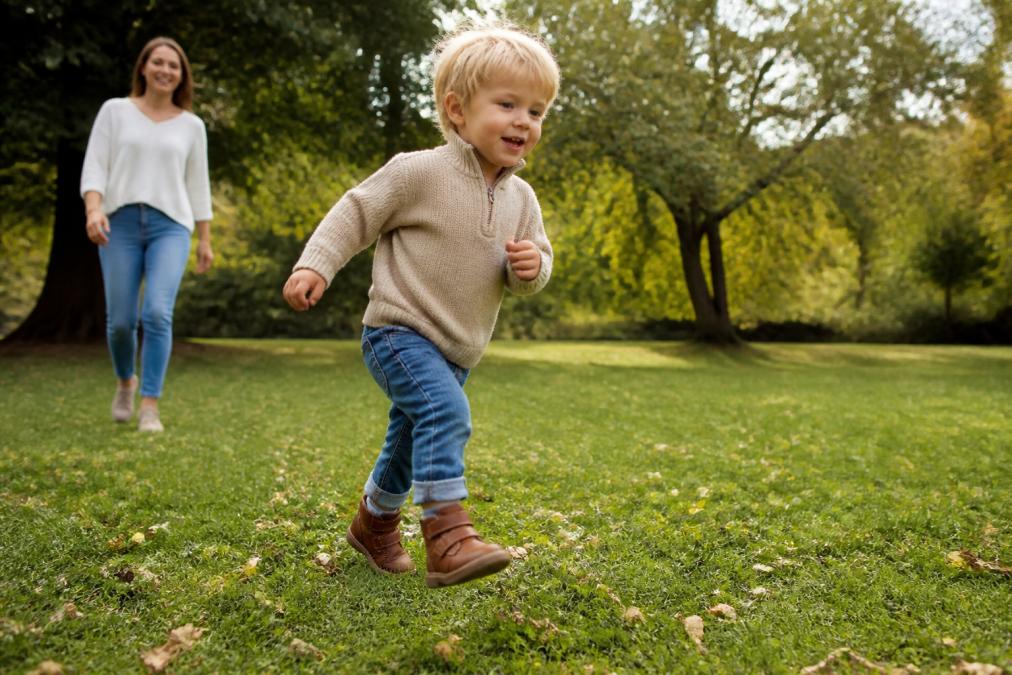
The range covers a lot of ground: from €69.90 for the Salt-Water Shark sandals up to €98.00 for the Emel winter velcro shoes, so there is a sensible option for every season and budget.
Froddo Barefoot TEX Autumn ankle boots, €83.95 to €89.95. Water-resistant leather upper, textile lining, zero heel drop, and a wider toe box that supports natural foot development. The double fastener adjusts to different foot widths, making this our default recommendation for normal to slightly wider feet. One limitation: the dark blue variant is not waterproof, only breathable, so check the colourway before buying for wet weather.
Emel winter velcro shoes, €98.00. The warmest option, handmade in Europe with natural wool lining and a water-resistant membrane. High-quality leather keeps the foot breathing in cold conditions. Best for deep winter and children who need genuine insulation, not just water resistance.
Emel winter booties with membrane, €84.99. A lighter winter boot with a polyester membrane lining and breathable leather upper. Easier for younger children to pull on independently, a good first proper winter shoe.
Salt-Water Shark sandal, €69.90. The warm-weather pick and the toughest sandal we carry. The woven semi-closed toe and heel protect against scuffs during football and scooting, the buckles are rust-proof, and the whole sandal can be handwashed. It runs shorter and narrower than others in the range, so size up, and it is not the best fit for wide feet.
Repair, Maintenance, and Sustainability: What Most Guides Skip
Almost no buying guide tells you what happens after month six, exactly when durability gets tested. Two things matter: whether the shoe can be repaired, and where the leather came from. We believe in providing comprehensive information.
Repair: What Is Worth Fixing (and What Is Not)
Most children's shoes are not worth resoling, because the cost approaches a new pair. But repair is not pointless, you just need to know which repairs extend life and which waste money.
Worth repairing:
- Stitching at the toe or heel, a cobbler can reinforce loose stitching for a fraction of a new shoe. This is the most common failure point we see on active kids' leather shoes.
- Scuffed toe caps, conditioning and polishing can restore the finish and prevent the scuff from becoming a crack.
- Loose buckles or velcro, Salt-Water sandals, for example, have replaceable buckles, and a cobbler can re-stitch velcro straps on most leather shoes.
- Insole replacement, if the upper is sound but the insole is compressed, a new insole can restore comfort and support.
Not worth repairing:
- Sole separation on cheap synthetic shoes, the bond between the upper and sole is the weak point, and re-gluing rarely holds under active play.
- Cracked leather at the flex point, once the fibres are broken, conditioner cannot rebuild them. This is why prevention matters more than repair.
- Membrane failure, if a waterproof membrane has delaminated, the shoe will leak no matter what you do.
Parents often replace shoes when a simple stitch repair would have added months of life. Ask your cobbler before you buy new.
Maintenance: The Rotation Habit That Doubles Shoe Life
Rotating between two pairs gives each shoe a full day to dry out, and that single habit measurably extends how long leather lasts. Moisture is the enemy of leather, and shoes worn every day never fully dry inside. The lining breaks down, the leather stiffens, and the flex point cracks.
Prompt cleaning after muddy play prevents the abrasion that wears through stitching. A shoe cleaned and conditioned every few weeks will outlast an identical unmaintained shoe, often by a full season.
Sustainability: Why Leather Sourcing Is a Durability Issue
Leather quality varies enormously and is not visible on the shelf. Look for leather from audited tanneries. Froddo, for instance, uses high-quality durable natural leather from LWG-audited suppliers.
Leather from audited tanneries is processed with controlled chemistry that preserves the hide's natural fibre structure. Cheaper leather is often over-processed with harsh chemicals that strip the fibres, making it more likely to crack, stiffen, or delaminate. Better hides resist cracking longer, so sourcing and durability are closely linked.
What to look for:
- LWG (Leather Working Group) certification, the most widely recognized audit for environmental and chemical management in tanneries.
- Vegetable-tanned or chrome-free leather, often softer and less likely to cause skin irritation, though not always as water-resistant as chrome-tanned leather.
- Brand transparency, a retailer who can tell you which tannery the leather came from is a retailer who has thought about durability. Vague answers usually mean vague leather.
The Bottom Line on Repair and Sourcing
Durability is not just about the first month. It is about whether the shoe can be maintained, repaired, and trusted after repeated wet-dry cycles. A shoe made from well-sourced leather, rotated with a second pair, and cleaned with the right method will outlast a cheaper shoe by a wide margin, the real cost-per-wear calculation most guides never make.
Frequently Asked Questions
Are leather shoes good for active kids?
Leather shoes work well for active children because the material flexes with the foot and resists scuffing better than most synthetics. Look for a flexible sole, a roomy toe box, and breathable leather so feet stay dry during play. Brands like Froddo and Emel use natural leather with water-repellent finishes, which handles playground wear without cracking. The key is fit: a properly sized leather shoe supports foot development and lasts through growth spurts better than a tight or oversized one.
How do you keep leather shoes from wearing out on active kids?
Rotate between two pairs so leather has time to dry, clean scuffs with a damp cloth and mild soap, and reapply a waterproofing spray every few weeks. For sandals like the Salt-Water Shark, handwash with gentle detergent and let them air dry away from direct heat. Avoid machine washing unless the manufacturer says it is safe. Prompt cleaning after muddy play prevents dirt from grinding into the leather grain, which is the main cause of premature wear.
What makes handmade leather shoes more durable than synthetic options?
Handmade leather shoes typically use higher-quality hides and durable stitching rather than glued seams, so they resist separation at stress points. Natural leather moulds to the foot over time, reducing friction that breaks down synthetic uppers. Well-made leather shoes can offer significant durability for active children. The trade-off is higher upfront cost, but the cost per month of wear is often lower.
How often should you replace active kids' shoes?
Check fit every eight to ten weeks during rapid growth periods. A child's foot can grow half a size in two to three months. Replace when there is less than 1 cm of space between the longest toe and the shoe front, when the sole is worn through, or when the upper no longer holds shape. Leather shoes with removable insoles let you inspect wear patterns. If the shoe still fits and the structure is intact, cleaning and re-waterproofing can extend its life by months.
Are handmade leather shoes worth the investment for growing feet?
Handmade leather shoes cost more upfront, but they support healthy foot development through flexible soles, wide toe boxes, and breathable materials. For children in Luxembourg, a proper fitting service ensures the shoe matches the foot shape, which reduces the risk of blisters and improper gait. When you factor in durability and potential for extended use, the investment in handmade leather shoes can be beneficial.