


Table of Contents
- Why Bunions Start in Childhood (And What Parents Can Do)
- Signs of Bunions in Children: What to Watch For
- What to Look for in Barefoot Baby Shoes: A Fitting Checklist
- Footwear Habits That Prevent Bunions in Children
- Barefoot Development Milestones: Why Free Toes Matter
- When to See a Podiatrist for Child Foot Pain
- The Emotional Side: Helping Adolescents Feel Confident About Their Feet
- Conclusion: Small Habits, Healthy Feet for Life
- Frequently Asked Questions
Last Updated: October 4, 2026
Why Bunions Start in Childhood (And What Parents Can Do)
Most parents think bunions are a problem for older adults. A bunion is a bony bump at the base of the big toe, at the metatarsophalangeal joint. In children, this is a juvenile bunion, and it can start forming before age ten.
At MintMouse, we fit children's shoes daily and see the early warning signs often. The good news: you can prevent bunions in most cases with the right habits early on.
Bunions in children rarely come from one cause. They develop from hereditary factors, biomechanics, and footwear fit, and that last one is the part you control.
- Genetics set the stage: foot shape and joint flexibility run in families
- Environment tips the balance: tight shoes, hard soles, and too little barefoot time
- Growth is the window: a child's foot is soft and still forming, so pressure now shapes the foot later
The NHS guidance on bunions notes that bunions often run in families, which means some children are more likely to develop them no matter what. Still, the daily choices you make can slow or stop the process.
Signs of Bunions in Children: What to Watch For
Catching a bunion early is easier than treating one later. The first sign is usually a small bump on the inner side of the big toe joint. It may look red or feel warm after a long day in shoes.
Watch for these signs of bunions in children:
- A visible bump at the base of the big toe
- Swelling or redness around the joint
- Complaints of pain after walking or sports
- Joint stiffness, especially in the morning
- Your child pulling off shoes as soon as they get home
- A big toe that starts leaning toward the second toe
Some children feel nothing; others feel sharp pain with every step, depending on how much inflammation builds up in the joint.
If your child complains about their feet more than once a week, check their shoes and gait.
What to Look for in Barefoot Baby Shoes: A Fitting Checklist
Barefoot shoes are best for growing feet: a wide toe box, thin flexible sole, and no heel lift let toes spread and grip the ground naturally.
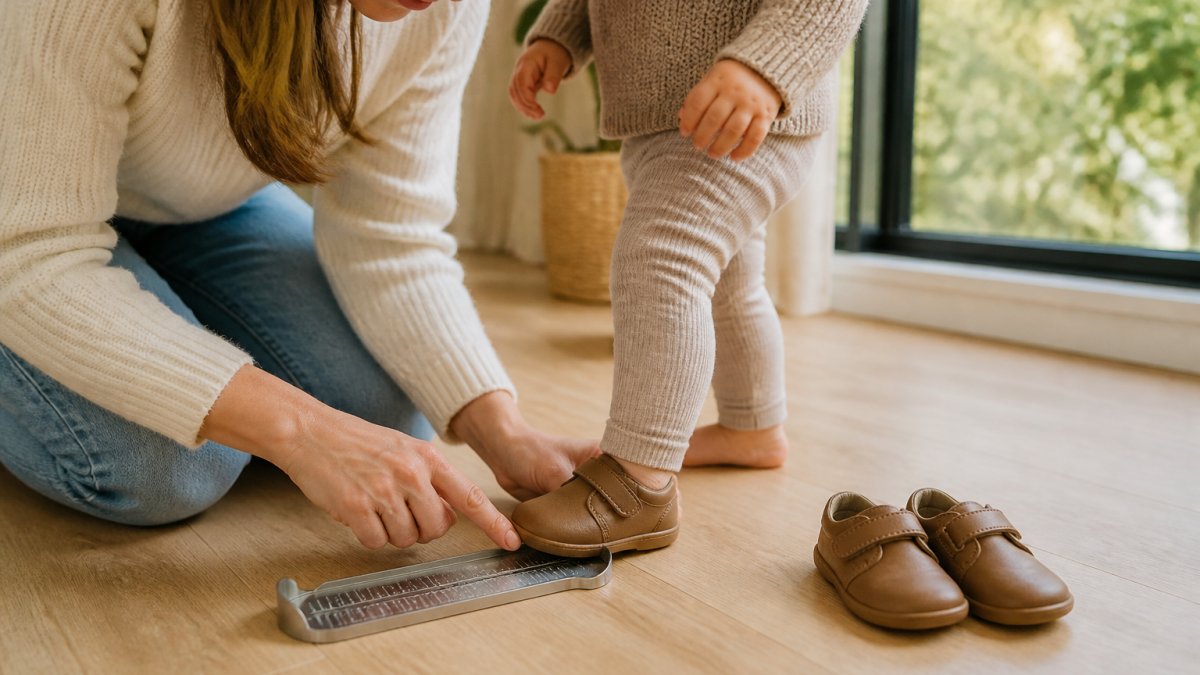
Use this checklist every time you buy shoes for a child under six.
- Toe box width: toes should spread flat, not touch each other
- Growing room: 10-12 mm of space in front of the longest toe
- Flexibility: the shoe should bend easily where the foot bends
- Heel hold: the heel should stay put without pinching
- Weight: light enough that your child forgets they are wearing shoes
- Flat sole: no raised heel, no arch that pushes into the foot
- Materials: breathable leather or textile, never stiff plastic
The Society of Chiropodists and Podiatrists guidance on children's footwear stresses that shoes should never need breaking in. If a shoe hurts on day one, it is the wrong shoe.
Our MintMouse fitting service measures both feet, checks the growing room, and matches the shoe to your child's foot shape. Our range runs from size 18 to 42.
Footwear Habits That Prevent Bunions in Children
Good shoes are only half the story, how and when your child wears them matters too. To prevent bunions long term, build these habits into your routine.
- Let your child go barefoot at home on safe surfaces
- Rotate two pairs of shoes so each pair dries fully
- Check fit every eight to ten weeks, since young feet grow fast
- Avoid hand-me-down shoes, which mold to another child's foot
- Skip tapered shoes that squeeze the toes into a point
- Choose barefoot shoes with a wide, natural shape
For colder months, the Froddo Children's Ankle Boots - BAREFOOT TEX AUTUMN BLUE+ at €89.95 has a spacious toe box, a flexible full-length sole, and a removable antibacterial leather insole. It suits normal to slightly wider feet and tightens on narrower ankles, but is not recommended for a high instep.

For rainy days, the BG401046_9441 Bundgaard Cover Navy Stripe at €47.00 is a barefoot rainboot with a wide fit, natural rubber, and a flexible sole, plus a 10-12 mm growth allowance built into the fit.

| Habit | What to Do | How Often |
|---|---|---|
| Barefoot time | Let toes spread on safe floors | Daily |
| Fit check | Measure toe room with a gauge | Every 8-10 weeks |
| Shoe rotation | Alternate two pairs | Daily |
| Shoe inspection | Look for worn soles and lost shape | Monthly |
| New shoes | Size up with 10-12 mm room | As needed |
Barefoot Development Milestones: Why Free Toes Matter
A child's foot is not a small adult foot.
Free toes do three things that shoes often block:
- Spread to build a wide, stable base
- Grip the ground to strengthen the arch
- Bend at the joint to build natural structural alignment
But barefoot time is not one-size-fits-all, the amount that helps changes with age. Here is a practical timeline.
0-6 months: Unlimited barefoot time
Before walking, feet are mostly cartilage and very pliable.
6-18 months: Barefoot for most waking hours
18 months-3 years: Barefoot at home, minimal shoes outdoors
Toddlers are building the arch and strengthening intrinsic foot muscles. Continue barefoot time indoors; outdoors, stick to minimal shoes that allow natural movement.
3-6 years: Balance barefoot play with supportive shoes for long walks
Preschoolers run, jump, and climb, so barefoot play on grass, sand, or safe indoor surfaces remains valuable.
6-12 years: Monitor for changes and adjust footwear
As activity increases, watch how shoes fit and wear. Children this age may need more cushioning for sports, but daily shoes should still allow natural toe spread.
12+ years: Support without restricting
Teen feet are nearly adult-sized but still growing.
Watch how your child walks on different surfaces. A child who trips often, or who walks on the outside of their feet, may need a gait analysis. This is one of the most useful things you can do before age seven, while the foot is still easy to guide.
Froddo Children’s Ankle Boots - BAREFOOT TEX AUTUMN BLUE+ (G3110266-12) →
Barefoot time is not a cure for hereditary risk. But it gives the foot the best chance to grow straight.
When to See a Podiatrist for Child Foot Pain
Do not assume your child will grow out of it. Some do. Many do not.
Book a visit if you notice:
- Pain that stops your child from walking or playing
- A bump that is growing or changing shape
- Redness, heat, or swelling that does not settle
- A big toe drifting toward the second toe
- Your child walking on the side of the foot
- Pain that wakes your child at night
But red flags vary by age. Here is what to watch for at each stage.
Infants and toddlers (0-3 years)
At this age, foot pain is rare and usually signals a structural issue. See a doctor for:
- A foot that turns inward or outward significantly
- Toes that overlap or curl under
- A persistent limp or refusal to walk
- Swelling, redness, or warmth in a joint
Many parents worry about flat feet in toddlers, but flexible flat feet are normal until age 3-4.
Preschoolers (3-5 years)
Children this age may complain of growing pains, but true foot pain should be evaluated. Watch for:
- Pain that limits activity or causes limping
- A bump at the base of the big toe
- Shoes wearing unevenly
- Tripping or falling more than usual
At this stage, a podiatrist can assess gait and recommend footwear changes before a deformity becomes fixed.
School-age children (6-12 years)
This is when juvenile bunions often become noticeable. Seek help if:
- Your child complains of pain after sports or long walks
- A bunion is visible or growing
- The big toe is angling toward the second toe
- Your child avoids activities they used to enjoy
Early intervention can slow progression and prevent the need for surgery later.
Teenagers (13+ years)
Teens may be self-conscious about foot problems and hide them. Watch for:
- Changes in walking style
- Reluctance to wear certain shoes
- Complaints of pain in the big toe joint
- Visible bump or redness
At this age, a podiatrist can discuss long-term management, including orthotics, footwear, and in rare cases, surgery.
A podiatrist will check the joint, watch how your child walks, and may suggest orthotics or arch support.
The NHS information on when to seek help for foot problems advises seeing a professional if pain affects daily life.
Do not wait for a bump to appear before acting. Many children feel pain and stiffness weeks before any visible change shows up. Ignoring early complaints lets a mild problem become a foot deformity that is much harder to correct.
The Emotional Side: Helping Adolescents Feel Confident About Their Feet
Foot problems are not just physical. By the teenage years, a bump, a limp, or shoes that never fit right can make a teenager self-conscious. Adolescent foot health is tied to how a young person feels about their body.
What helps:
- Let your teen pick their own shoes from a range that fits well
- Explain that many foot shapes run in families, so it is not their fault
- Focus on comfort and function, not just looks
- Involve them in the fitting so they feel in control
The Bisgaard Barefoot Baloo at €79.95 features natural breathable leather, a reinforced rubber toe cap, a fixed heel cap, and a lightweight non-slip sole. It is handmade in Portugal and free from harmful chemicals.

A teenager who likes their shoes will actually wear them. That alone supports better foot health.
Conclusion: Small Habits, Healthy Feet for Life
Bunions in children are easier to prevent than to fix. The habits you build now, from barefoot time to proper footwear fit, shape how your child's feet develop for decades.
At MintMouse, we help families in Luxembourg find shoes that support healthy growth. Our expert fitting service measures both feet and checks the growing room. Our handmade leather range runs from size 18 to 42, with barefoot options for every season and multilingual support for expat families.
Get started with MintMouse and give your child shoes that let their feet grow the way they should.
Frequently Asked Questions
Why does my 7 year old have bunions?
Bunions in children often come from a mix of genetics and footwear. If a parent or grandparent has bunions, a child is more likely to develop them because foot shape and joint structure run in families. Shoes that taper at the toe, are too narrow, or are handed down before the previous pair has worn in can also push the big toe out of alignment over time. A podiatric evaluation can confirm whether the bump is a juvenile bunion or another foot deformity.
Can you reverse a bunion naturally?
You cannot reverse a bunion once the joint has shifted, but you can slow it down and manage symptoms in children. Conservative treatment includes wide toe box shoes, orthotics, cold compress for inflammation, activity modification, and stretching to keep the joint flexible. Because children are still growing, early changes to footwear and barefoot time often make a bigger difference than they would in adults. Surgery is rarely recommended before the bones stop growing.
Do shoes cause bunions in children?
Shoes alone rarely cause bunions, but the wrong shoes can speed up a bunion that was already developing. Tapered shoes, tight toe boxes, and shoes without growing room put pressure on the metatarsophalangeal joint and can worsen alignment over time. Look for barefoot shoes with a spacious toe box, a flexible sole, and 10 to 12 mm of growing room. Barefoot time at home also helps the toes move naturally and supports healthy biomechanics.
What are the early signs of bunions in children?
Early signs include a small bump at the base of the big toe, redness or swelling after wearing shoes, joint stiffness in the morning, and your child complaining about pressure points or pain when walking. Some children show no pain at all, which is why regular fit checks matter. If you notice a bump forming or your child avoids certain shoes, book a podiatric evaluation rather than waiting for the pain to get worse.