


Table of Contents
- Quick Comparison: Best Shoes for Wide Toddler Feet
- How to Measure Toddler Feet at Home (Without a Fitting Gauge)
- Signs Toddler Shoes Are Too Tight (And What Parents Miss)
- What Actually Matters in Wide-Fit Toddler Shoes
- Best Barefoot Shoes for Wide Feet: What to Look For in 2026
- Budget vs. Premium: What You're Actually Paying For
- Caring for Wide-Fit Toddler Shoes So They Last
- Frequently Asked Questions
Last Updated: September 20, 2026
Quick Comparison: Best Shoes for Wide Toddler Feet
Finding the best shoes for wide toddler feet starts with knowing width matters as much as length. At MintMouse, we fit children daily, and the most common mistake is buying shoes that are long enough but too narrow. A shoe that squeezes the toes restricts natural foot development, affects gait, and creates pressure points that worsen over time.
| Shoe | Price | Best For | Key Feature |
|---|---|---|---|
| Rainboots Cover | €45.00 | First walkers, wet weather | Super flexible sole, wide fit |
| Thermo Rainboots | €60.00 | Cold, wet winter days | Wool lining, removable wool soles |
| Froddo Barefoot Sandals | €71.50 | Warm-weather walking | Adjustable velcro, wide toe box |
| Kapi Exclusive Booties | €79.00 | Babies, winter walks | Wide step-through, leather upper |
| Kabriel Barefoot High Trainers | €108.95 | Active toddlers | Wide toe box, anti-slip flexible sole |
How to Measure Toddler Feet at Home (Without a Fitting Gauge)
You can measure toddler feet at home with paper, a pencil, and a ruler. No gauge is needed, and tracing is often more reliable than an in-store measurement because your child is relaxed and standing naturally.

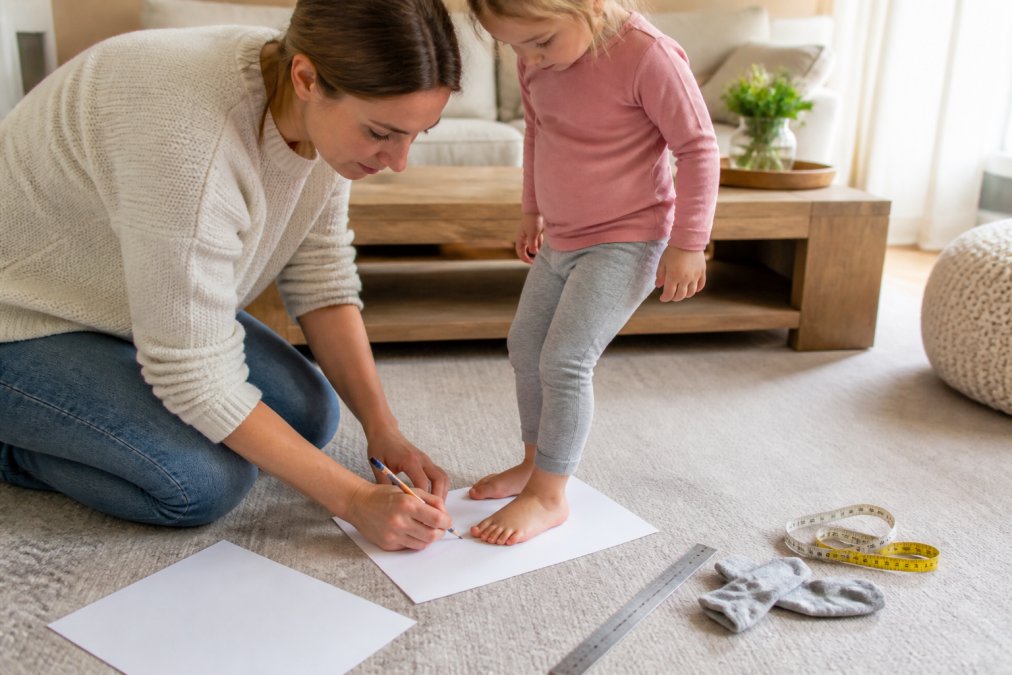
The Paper Tracing Method
Follow these steps for a reliable measurement:
- Place a sheet of paper against a wall on a hard floor.
- Have your child stand with their heel touching the wall.
- Hold the pencil vertical and trace around the whole foot.
- Repeat for both feet, since one is often slightly larger.
- Measure from the heel line to the longest toe in centimetres.
- Add 10 to 12 mm of growth allowance before choosing a size.
Always measure at the end of the day, when feet are slightly swollen; a morning measurement can underestimate the true size.
Reading Width, Not Just Length
Length alone tells you nothing about fit. Trace the widest part of the foot, usually across the ball, and compare it to the shoe's internal width. A foot that measures wide at the ball but narrow at the heel needs an adjustable closure to hold the heel without squeezing the toes.
Signs Toddler Shoes Are Too Tight (And What Parents Miss)
Most parents notice too-small shoes only after the toes are cramped. Toddlers cannot always say a shoe hurts, so watch for behaviour instead. The signs below are grouped by what they mean, because the same symptom can point to a width, length, or instep problem.
Behavioural Signs
- Your child pulls at their shoes or tries to take them off shortly after putting them on
- They walk on their toes or refuse to run when they normally would
- They trip more often than usual, especially on flat ground
- They ask to be carried more during walks they used to enjoy
These behaviours usually appear within 10 to 15 minutes of wearing the shoe. A shoe that only hurts once the foot warms up and swells is often too narrow across the ball.
Physical Signs on the Foot
Check your child's bare feet after a day of wearing the shoes. Look for:
- Red marks or pressure points on the sides of the foot, especially at the widest part
- Indents or redness on the top of the foot, across the bridge
- Blisters or hot spots on the heel or toes
- Toes that curl under or cross over each other when the shoe comes off
The Insole Removal Test
A simple at-home test confirms whether a shoe is genuinely wide enough. Pull out the removable insole and have your child stand on it barefoot.
What Parents Miss Most: The Instep
A shoe can be the right length and width but still press on a high instep, causing discomfort that looks like a width problem. If the top of the foot is red but the sides are fine, the issue is height, not width.
When to Re-Measure
Any time you see one of these signs, re-measure before buying a new size. Measure length and width at the ball and compare the new tracing to the old one. If only the length has changed, you need a longer shoe in the same width; if the width has grown, you may need a wider style entirely.
What Actually Matters in Wide-Fit Toddler Shoes
Three design features separate a genuinely wide shoe from one that is simply labelled that way.
Wide Toe Box, Flexible Sole, Secure Heel
A wide toe box lets toes splay naturally, supporting balance and healthy foot development. The flexible sole should bend easily where the foot bends, letting the muscles work. A secure heel stops the foot sliding forward, which jams toes against the front.
BG401057_3469 Thermo Rainboots Blush →
High Instep vs. Wide Width: Two Different Problems
A high instep and a wide foot are not the same thing. A wide foot needs more room side to side; a high instep needs more room top to bottom, across the bridge.
Best Barefoot Shoes for Wide Feet: What to Look For in 2026
Barefoot shoes for wide toddler feet share a set of features: a flat sole with no heel drop, a wide toe box that follows the natural foot shape, and a thin, flexible outsole that lets the foot move, supporting foot development rather than restricting it. Prioritizing this natural range of motion ensures that the rest of the body remains properly aligned, much like how selecting the correct toddler clothing sizes prevents unnecessary bunching or restriction during active play.
Budget vs. Premium: What You're Actually Paying For
Price in toddler shoes reflects materials and construction, not branding. Understanding the difference helps you decide where to spend, especially since wide-fit styles often cost more than standard-width shoes at the same size.
Why Wide-Width Shoes Often Cost More
Wide-fit toddler shoes are not simply standard shoes made bigger. They need separate lasts (the foot-shaped molds a shoe is built around), meaning smaller production runs and higher per-unit tooling costs. A brand offering three widths needs three times the inventory, and that cost is passed on.
What Materials Actually Do for Foot Health
| Material | What It Does | Trade-Off |
|---|---|---|
| Natural rubber | Flexible, waterproof, holds shape | Heavier than synthetic mesh |
| Leather | Breathes, molds to the foot over time | Needs care, costs more |
| Synthetic mesh | Light, breathable, quick-drying | Less durable, can lose shape |
| Wool lining | Regulates temperature, soft against skin | Can be warm in summer |
| Bamboo lining | Moisture-wicking, odour-resistant | Less common, higher cost |
For foot health, the priority is breathability and flexibility, not softness. A soft shoe that loses its shape lets the foot slide, defeating the purpose of a wide fit. Leather and natural rubber hold shape while allowing movement, which is why they appear in most wide-fit toddler shoes at every price point.
Where Budget Shoes Cut Corners
A €45 wide-fit shoe can still be good. What you typically give up:
- Colour and style variety, because budget lines run fewer options
- Lining quality, often synthetic instead of leather or bamboo
- Sole durability, which matters if the shoe is worn daily
- Resale or hand-me-down value, since cheaper materials break down faster
Where Premium Shoes Add Value
A €100+ shoe typically adds:
- Leather or suede uppers that mold to the foot and breathe better
- Reinforced toe caps that survive scooting and dragging
- Removable insoles that let you check fit and replace worn liners
- Construction that holds shape after months of daily wear
For a child wearing the same pair daily, that durability often justifies the cost; for a child rotating two or three pairs, a mid-range leather option is often smarter.
Caring for Wide-Fit Toddler Shoes So They Last
Check the fit every few weeks by pressing a thumb against the front of the shoe while your child stands. You want roughly 10 to 12 mm between the longest toe and the front; if there is less, it is time for a new size.
Frequently Asked Questions
How do I know if my toddler needs wide-width shoes?
Stand your child on a sheet of paper and trace both feet. Measure the widest point across the ball of the foot, then compare it with the insole width of the shoe you're considering. If the shoe presses on the sides of the foot or leaves red marks after twenty minutes of wear, it's too narrow. Children with wide toddler feet also tend to have a high instep, so check that the closure still adjusts comfortably over the top of the foot.
Are barefoot-style shoes better for wide toddler feet?
Barefoot shoes are a strong match for wide toddler feet because they typically use a wide toe box that lets toes splay naturally, plus a thin, flexible sole that lets the foot feel the ground. Look for a flat sole with no heel drop, a fixed heel counter for stability, and a breathable upper. Barefoot styles work best for first walkers and confident toddlers; if your child needs extra cushioning for long days on hard surfaces, a slightly thicker flexible sole is fine.
How often should I check if my toddler's shoes still fit?
Check every six to eight weeks during growth spurts, and always before a new season. Toddler feet can grow half a size in two months. Aim for 10 to 12 mm of space between the longest toe and the front of the shoe, which covers natural foot movement when walking. If the toe box feels tight, the heel slips, or your child starts refusing to put the shoes on, it's time to size up.
Can I measure my toddler's feet at home without a fitting gauge?
Yes. Trace both feet on paper while your child stands, mark the heel and the longest toe, then measure the distance in centimetres. Add 10 to 12 mm for growth allowance. Measure width at the widest point too, since length alone won't tell you if the shoe is wide enough. Repeat the tracing every few months, because feet also change shape as toddlers start running and jumping.
What should I do if my toddler has wide feet and nothing seems to fit?
Start with shoes that specify a wide or extra wide fit and use adjustable closures like hook and loop or velcro, so you can fine-tune the fit around the instep. Avoid slip-on styles with no adjustment, since they can't accommodate a wider foot. If your child's feet are unusually wide or one foot is noticeably wider than the other, an in-person fitting with a specialist will save you from buying and returning multiple pairs.