


Table of Contents
- Why Healthy Footwear for First Steps Matters
- Benefits of Soft Sole Shoes for Babies
- What to Look For in Barefoot Baby Shoes
- How to Measure Baby Feet at Home
- Signs of Poor Shoe Fit in Toddlers
- Top Healthy Footwear Picks for First Steps
- Conclusion
- Frequently Asked Questions
Last Updated: September 16, 2026
Why Healthy Footwear for First Steps Matters
A baby's foot is mostly cartilage at birth, and the arch only forms once walking starts. What a child wears in those first months helps shape how their feet develop for life, which is why healthy footwear for first steps matters more than most parents realise.
This guide from MintMouse covers the anatomy, fit checks and buying decisions that support healthy foot development: measuring feet at home, spotting a bad fit early, and choosing shoes that let young feet move as designed.
Healthy footwear is footwear that protects the foot without restricting it: a flexible sole, a wide toe box, secure closures and breathable materials. Everything else is decoration.
The stakes are higher than they look. Podiatrists and children's footwear specialists consistently advise that shoes for new walkers should mimic barefoot conditions as closely as possible, because barefoot movement builds strength in the foot muscles and gives the brain reliable sensory feedback with every step. Guidance from the NHS on children's foot health makes the same point: children's feet need room to grow and move, and tight or rigid shoes work against that.
Benefits of Soft Sole Shoes for Babies
Soft sole shoes let a baby's foot bend, grip and feel the ground, supporting muscle development and balance. A rigid sole holds the foot in one position and removes the sensory input that tells the brain where the foot is in space.
The sensory mechanism: proprioception and the sole
Proprioception is the body's sense of where its parts are and how they move, fed by receptors in the muscles, joints and skin of the feet. Every barefoot step tells the brain the floor is hard, the rug is soft, the step edge is here. A thick, stiff sole blunts that signal; a thin, flexible sole preserves most of it.
This matters most in the first months of walking, when the brain is still building the map it will use for balance for life.
Gait, balance and muscle development
Soft soles also encourage a natural gait. Toddlers in flexible shoes land more flatly and push off more evenly than children in stiff-soled shoes, who often adapt by walking on their toes or with a wider stance, compensatory patterns a child may keep long after the shoe is outgrown.
Where soft soles fall short
Where soft soles fall short is protection. On gravel, hot pavement or rough terrain, a thin sole offers little cushioning, and a child who feels every pebble may refuse to walk. Many parents keep a sturdier pair for outdoors and a soft pair for indoor and early walking practice: match the shoe to the surface so the foot gets sensory input without getting hurt.
What to Look For in Barefoot Baby Shoes
Barefoot baby shoes should be flexible, wide, flat and light. Those four properties cover most of what matters, and they're easy to test by hand in a shop.
Sole Flexibility and Grip
A good first-walker sole bends in every direction and returns to shape. Twist it, fold it, roll it. If it resists, the shoe will resist your child's foot too.
Wide Toe Box and Heel Stability
The toe box should be wide enough that all five toes sit flat and can spread. A tapered toe box squeezes the toes inward over time, and clinicians associate that pressure with later toe deformities.
Closures, Materials and Breathability
Adjustable closures matter more than most parents expect: hook-and-loop straps fine-tune the fit around a high instep or narrow ankle, and let a child put shoes on independently later.
Froddo Barefoot FIRST STEP - Dark BLUE →
| Feature | What to Check | Why It Matters |
|---|---|---|
| Sole | Bends in all directions, non-slip | Supports natural movement and traction |
| Toe box | Wide, toes can splay flat | Prevents toe compression |
| Heel | Firm counter, no slip | Keeps the foot centred |
| Closure | Adjustable hook-and-loop | Accommodates unusual foot shapes |
| Material | Breathable, chrome-free leather | Manages moisture, kinder to skin |
| Weight | Noticeably light in hand | Reduces fatigue for new walkers |
How to Measure Baby Feet at Home
Measure both feet in the afternoon, standing up, and add 8-12 mm of growth room to the longest measurement. Feet swell during the day, and a standing measurement captures true length under load.
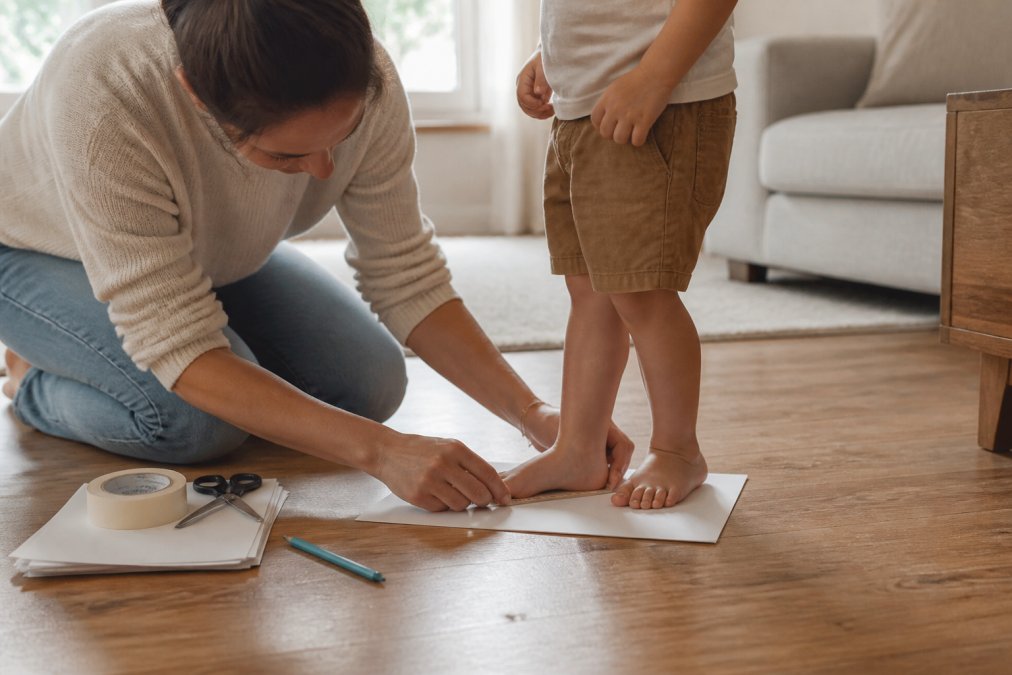
Here's the method that works reliably:
- Stand your child on a sheet of paper against a wall, heel touching the wall.
- Mark the tip of the longest toe. Repeat for the other foot.
- Measure from the wall edge to each mark in centimetres.
- Use the longer foot as your reference.
- Add 8-12 mm for growth room and compare against the insole length of the shoe, not the outer sole.
Signs of Poor Shoe Fit in Toddlers
The clearest signs of a bad fit are a child who pulls their shoes off, trips more than usual, or walks differently in shoes than barefoot. Any of those is worth investigating before assuming it is a phase, and the harder question is what to do when standard fit advice does not suit your child's foot shape.
The quick fit check
Watch for these specific signals after a normal day of wear:
- Red marks or pressure lines on the toes, heel or instep
- Toes curling or overlapping inside the shoe
- The child walking on their toes only when wearing shoes
- Heel slipping out of the shoe with each step
- Reluctance to walk or run in shoes they used to wear happily
- Visible wear on one side of the sole only
Troubleshooting: wide feet, high insteps and narrow heels
Standard sizing assumes an average foot. Many children do not have one. Here is how to handle the three most common mismatches.
When a child refuses to wear shoes
Shoe refusal is usually a fit problem, not a behaviour problem. Check the three most common causes: pressure points (red marks after short wear), a sole too stiff to bend with the foot, and a shoe too heavy for a new walker to lift. A child who walks happily barefoot but refuses shoes is telling you the shoe is doing something the foot does not like.
Top Healthy Footwear Picks for First Steps
The best first-step shoes combine a flexible sole, a wide toe box and adjustable closures, and the Froddo barefoot FIRST STEP range meets all three. MintMouse stocks the full range in sizes built for the first walking months.
| Shoe | Price | Upper | Closure | Best For |
|---|---|---|---|---|
| Froddo Barefoot FIRST STEP | €75.95 | Natural leather | Double hook-and-loop | Everyday first walking |
| Prewalker Leather Walky Elephant | €69.99 | Embossed suede | Hook-and-loop | Warmer days, toe protection |
Conclusion
Choosing the first pair of shoes feels like a small decision and isn't. Flexible soles, a wide toe box, adjustable closures and breathable materials do the real work, and no amount of styling compensates for a poor fit.
Frequently Asked Questions
What shoes do pediatricians recommend for first walking?
Pediatricians generally recommend soft, flexible footwear that lets a baby's foot move naturally. Look for a flexible sole that bends easily, a wide toe box so toes can splay, breathable materials like natural leather, and a secure closure such as hook-and-loop. Barefoot-style shoes, including options like Froddo Barefoot FIRST STEP, meet these criteria. Avoid stiff or hard-soled shoes until walking is well established, and check the fit every few weeks as feet grow quickly.
How do I know if my baby's shoes fit correctly?
Check for at least a thumb's width of space between the longest toe and the shoe front, and make sure the heel doesn't slip when your child walks. Press the upper to feel for toes curling or crossing. If you see red marks, blisters or your child tugging at the shoes, they likely need a different size. Measure feet every 6 to 8 weeks, as toddler feet can grow half a size in that time.
Should babies wear shoes indoors when learning to walk?
For most healthy babies, barefoot time indoors is best because it strengthens foot muscles and improves balance through sensory feedback. Shoes are mainly for protection outdoors or on rough, cold surfaces. If your home has hard floors or you want extra grip, a lightweight soft-sole shoe or prewalker like the Affenzahn Prewalker Leather Walky Elephant can be a good compromise, but let your baby spend plenty of time barefoot too.
What is the difference between soft-sole and hard-sole shoes for toddlers?
Soft-sole shoes flex with the foot, allowing natural movement and letting your toddler feel the ground, which supports balance and proprioception. Hard-sole shoes are stiffer and offer more protection but restrict foot motion. For first steps, soft-sole or barefoot designs are generally recommended. Once walking is confident and your child is on uneven ground, a slightly more protective sole can be useful. Always prioritise flexibility and fit over stiffness.
How often should I check my toddler's shoe size?
Check the fit every 6 to 8 weeks during the first two years, when feet grow fastest. Signs like toe marks, difficulty putting shoes on, or your child resisting walks mean it's time to remeasure. A professional fitting service can help confirm the right size, and many parents find a quick in-store check every couple of months saves guesswork. Remember to measure both feet, as one is often slightly larger.