


Table of Contents
- How Often Should You Measure Your Toddler's Feet?
- How to Measure Toddler Feet at Home
- Signs Toddler Shoes Are Too Small
- How Much Room Should Be in Toddler Shoes
- Why Proper Fit Matters for Foot Development
- Common Mistakes When Measuring Feet
- Sensory-Friendly Measuring Techniques
- Frequently Asked Questions
Last Updated: September 18, 2026
How Often Should You Measure Your Toddler's Feet?
Your toddler's feet are growing faster than you might realize. Measuring them regularly is one of the simplest things you can do to support healthy foot development. At MintMouse, we know that proper shoe fit matters more than most parents think, it shapes how your child walks, runs, and develops their feet for years to come.
Most toddlers need their feet measured every 6 to 8 weeks. This frequency catches growth before shoes become too tight, which can affect balance, gait, and comfort. Some children grow faster than others, so watching for warning signs between measurements keeps you ahead of outgrown shoes.
The real question isn't just how often, but why consistency matters. A shoe that fits perfectly today might pinch in six weeks. Catching that moment before it happens prevents discomfort and supports the natural development of your child's foot structure.
Growth rates for toddlers vs. older children
Toddlers grow at a remarkable pace. Between ages 1 and 3, children's feet can grow a full shoe size every 2 to 3 months. This rapid growth slows down slightly as they get older, by age 4 or 5, growth typically happens every 3 to 4 months.
The difference matters for your measurement schedule. A 2-year-old needs checking more frequently than a 4-year-old. Younger toddlers are also less able to tell you when shoes feel tight, so regular checks protect them from discomfort they can't communicate.
Growth isn't always steady either. Some months your child's feet barely change. Then suddenly they jump a half-size or more. This unpredictability is exactly why a routine measurement schedule works better than waiting for complaints.
Seasonal growth spurts and measurement timing
Growth spurts often happen in spring and early summer. Your toddler might outgrow shoes faster during these months. Fall and winter typically see slower growth, but it still happens.
Plan your measurements around these patterns. Check feet more frequently during peak growth seasons. In slower months, you can stretch the time between checks to 8 or even 10 weeks if the current shoes still fit well.
This approach saves money and hassle. You'll buy fewer shoes that go unworn because your child outgrows them before wearing them out.
How to Measure Toddler Feet at Home
You don't need special equipment to measure your toddler's feet accurately. A few simple tools and the right technique give you reliable measurements every time.
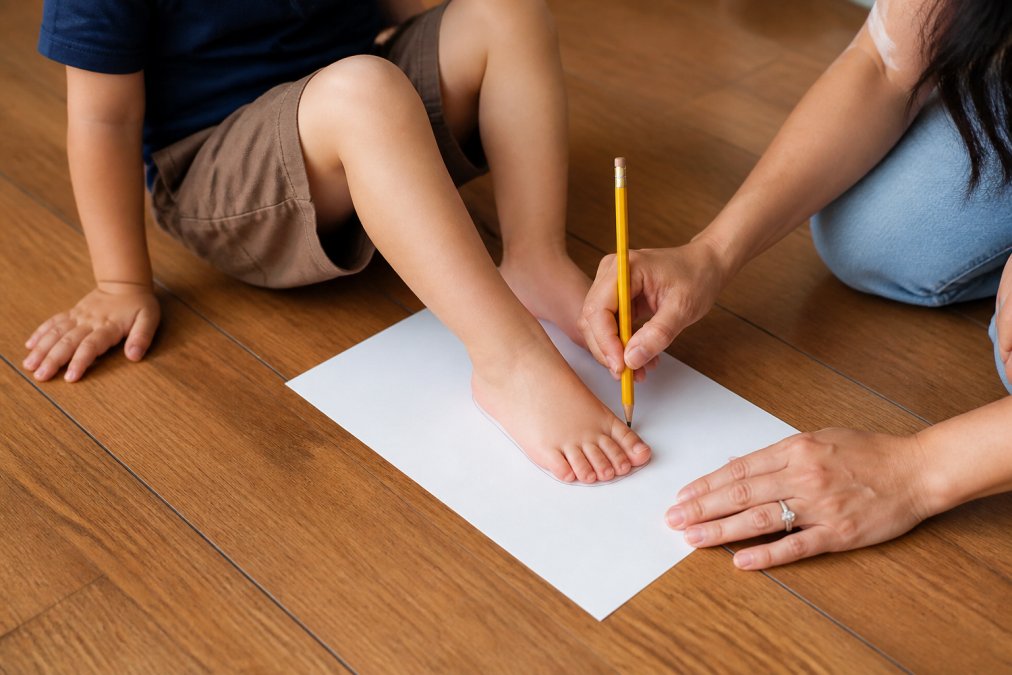
Paper tracing method
The paper tracing method is the most accurate way to measure at home. Have your child stand barefoot on a piece of white paper. Use a pencil to trace around the entire foot, keeping the pencil vertical and close to the skin.
Mark the longest point from heel to toe on your tracing. Measure this distance with a ruler or measuring tape. This gives you your child's foot length in centimeters or inches.
Do both feet, they're rarely exactly the same size. Use the larger measurement when choosing shoes. Always measure with your child standing, not sitting, because standing weight shows the foot's true length.
Tips for measuring wiggly toddlers
Wiggly toddlers make measuring tricky. Try these approaches to keep your child still:
- Measure during calm moments, after a snack or quiet play works better than during active time
- Make it a game: "Let's draw around your foot" feels more fun than "we need to measure you"
- Use colorful markers or pencils to make tracing feel like an art project
- Let your child hold the pencil or paper to feel involved
- Keep sessions short, trace one foot, then take a break before the other
- Measure multiple times if the first attempt looks off, consistency matters more than speed
Some children cooperate better in the morning. Others do well right before bed. Know your child's rhythm and measure when they're most likely to stay still.
The impact of socks on fit
Socks matter more than most parents realize. Thick socks take up space inside the shoe. A shoe that fits perfectly with thin socks might feel snug with winter socks.

When measuring, have your child wear the type of socks they'll actually wear in the shoes most often. If they'll wear thick winter socks, measure with those on. For summer shoes worn with thin socks, measure accordingly.
This prevents the frustration of buying shoes that fit in the store but feel tight once your child wears them with regular socks. The fit changes based on what goes inside the shoe, so account for it from the start.
Signs Toddler Shoes Are Too Small
Catching tight shoes early prevents foot problems and discomfort. Watch for these clear signs that it's time for a larger size.
Anti-slip Terry cotton socks - Soft Pink →
Visual indicators of tight shoes
Look at the shoe itself for physical signs of tightness. Red marks on the foot or toes after wearing shoes indicate pressure points. The skin might look slightly indented where the shoe presses.
Check the toe box, there should be visible space between your child's longest toe and the end of the shoe. If the toes look cramped or curled, the shoe is too small. Press gently on the top of the shoe above the toes. You should feel some give, not a tight surface.
Heel slipping can also signal a problem. If the shoe is too tight in the toe box, your child's heel might slip as they try to compensate. This creates an unstable walking pattern.
Behavioral signs your toddler is uncomfortable
Your child might not say "my shoes hurt," but their behavior tells you plenty. Watch for these signals:
- Refusing to wear shoes or taking them off constantly
- Walking differently, limping, tiptoeing, or shuffling instead of their normal gait
- Increased fussiness or complaints about feet during the day
- Blisters, raw spots, or redness on the heel or toes
- Tripping more often or seeming less confident while walking
These signs mean the shoes need replacing. Don't wait for your child to complain, their behavior is the complaint.
How Much Room Should Be in Toddler Shoes
The right amount of space in a shoe matters for healthy foot development. Too tight causes problems. Too loose creates instability.
The wiggle room standard and why it matters
The standard recommendation is a thumb's width of space between your child's longest toe and the end of the shoe. This means roughly half an inch (about 1 centimeter). This space allows for natural foot movement without the shoe being loose.
Press your thumb into the space. If it fits snugly, the fit is right. If you can fit more than one thumb width comfortably, the shoe is too large. If your thumb barely fits or doesn't fit at all, the shoe is too small.
This wiggle room lets your child's foot move naturally as they walk and run. It prevents pressure points while keeping the heel stable. The shoe should feel snug around the heel and midfoot but have clear space at the toes.
Understanding shoe size charts and half-sizes
Toddler shoe sizing can be confusing because different brands use different measurements. A size 5 in one brand might fit differently than a size 5 in another.
Always measure your child's foot length and compare it directly to the shoe brand's size chart. Don't rely on "they wore a size 4 last time." Brands vary, and your child's feet change.
Half-sizes exist for a reason. If your child's foot measures between two whole sizes, the half-size usually fits better than sizing up.
Why Proper Fit Matters for Foot Development
Shoes shape how your child's feet develop. Poor-fitting shoes don't just cause immediate discomfort, they can affect gait, balance, and long-term foot health.
Common Mistakes When Measuring Feet
Most parents make at least one of these mistakes when measuring. Knowing what to avoid saves time and prevents buying shoes that don't fit.
Sensory-Friendly Measuring Techniques
Some toddlers find standard measuring stressful. If your child struggles with the tracing method or sitting still, try these sensory-friendly approaches.
| Measurement Method | Best For | Time Needed | Accuracy |
|---|---|---|---|
| Paper tracing | Most toddlers | 5-10 minutes | Very high |
| Foot gauge | Quick checks | 2-3 minutes | High |
| Shoe fitting | In-store | 10-15 minutes | Very high |
| Sensory method | Anxious children | 10-15 minutes | High |
Frequently Asked Questions
How often should you measure a 2-year-old's feet?
Measure your 2-year-old's feet every 6-8 weeks. At this age, toddlers experience rapid growth spurts, and shoes can become too small quickly. Regular measurement ensures your child always has proper fit and prevents discomfort or foot development issues. If you notice signs of tight shoes sooner, measure immediately rather than waiting for the scheduled interval.
What is the best way to measure a toddler's foot at home?
The paper tracing method works best for measuring toddler feet at home. Place your child's bare foot on a sheet of paper and trace around it with a pencil, keeping the pencil vertical. Measure from the heel to the longest toe with a ruler. For wiggling toddlers, try measuring while they're watching a favorite show or distracted with a toy.
How much growing room should be in a toddler's shoe?
Leave approximately 1-1.3 centimetres (about half a finger's width) of space between your toddler's longest toe and the end of the shoe. This wiggle room allows for natural foot movement and growth without the shoe being so loose it causes tripping. The shoe should feel snug around the heel and instep but not tight. Avoid excessive space, as too much room can affect balance and gait development.
How can I tell if my toddler's shoes are too small?
Watch for red marks on the foot after removing shoes, complaints of discomfort, reluctance to walk, or your child removing shoes frequently. Check the toe box by pressing gently on the shoe's end, you should feel a small gap. If your toddler's toes are curled or pressed against the end, the shoe is too small. Also inspect for heel slipping, which suggests the shoe no longer fits properly and needs replacing.