


Table of Contents
- Why Professional Shoe Fitting Matters for Growing Feet
- Signs Toddler Shoes Are Too Small (And What Parents Miss)
- How Often to Refit Children Shoes: A Practical Schedule
- What to Bring to a Shoe Fitting Appointment
- What Happens During an Expert Shoe Fitting Appointment
- DIY Measurement vs Professional Fitting: What the Tape Measure Misses
- After the Fitting: Caring for Leather Shoes and Planning the Next Visit
- Frequently Asked Questions
Last Updated: September 13, 2026
Why Professional Shoe Fitting Matters for Growing Feet
A child's foot is not a miniature adult foot. At birth it is largely cartilage, and the bones that will eventually carry them for a lifetime do not finish hardening until the teenage years (peer-reviewed research). That soft, developing structure is why shoe fitting is a health decision, not a shopping preference. When you book expert shoe fitting service, you are buying a measurement of how a specific foot moves, grows and bears weight, not just a size number on a box.
This guide from MintMouse walks through the full process: the signs a shoe has been outgrown, a realistic refit schedule, what to bring, what happens in the appointment, and how to care for leather shoes afterward.
Here is what most parents miss. Children do not reliably report foot pain. Their feet are flexible, their nerve endings are still maturing, and a shoe that pinches today becomes the shape their foot adapts to tomorrow. The NHS guidance on children's foot health is clear that ill-fitting footwear in childhood can contribute to later problems, which is why regular checking matters more than buying the "right" pair once.
Signs Toddler Shoes Are Too Small (And What Parents Miss)
The clearest sign is a toe pressed against the front of the shoe, but by the time you notice that, the shoe has usually been too small for weeks. A better test is the thumb-width check: press your thumb between the longest toe and the shoe's front edge while your child stands. You should feel roughly a thumb's width of space.
What parents consistently miss:
- Toe box width. A shoe can be the right length and still squeeze the toes. Look for a wide, rounded toe box that lets toes splay.
- Foot volume. A high instep or chubby foot can make a correctly sized shoe feel tight across the top. Fastenings that adjust across the instep solve this; a fixed opening does not.
- Wear patterns on the sole. Uneven wear suggests a gait pattern worth discussing at a fitting.
- Reluctance to walk. A toddler who suddenly wants to be carried may be telling you something the shoe is doing.
How Often to Refit Children Shoes: A Practical Schedule
For children under three, check the fit every six to eight weeks and expect a new pair roughly every three to four months (the NHS). Between three and five, check every two to three months. After five, check every three to four months, with growth spurts often clustering in spring and autumn.

Growth is not linear. A child can sit in the same size for months and then jump half a size in a few weeks. That is why the calendar matters less than the check itself. Mark a recurring reminder in your phone and treat it as a standing appointment.
| Age Range | Fit Check Frequency | Typical New Pair |
|---|---|---|
| Under 3 years | Every 6-8 weeks | Every 3-4 months |
| 3-5 years | Every 2-3 months | Every 4-5 months |
| 5+ years | Every 3-4 months | Every 5-6 months |
| During a growth spurt | Every 3-4 weeks | As needed |
What to Bring to a Shoe Fitting Appointment
Bring the shoes your child is currently wearing, even if they look fine. The wear pattern on the sole and the creasing across the upper tell a fitter more about gait and fit than a fresh measurement alone. Also bring the socks your child normally wears, since sock thickness changes the fit by a meaningful margin.
A short preparation checklist:
- Current shoes, worn pair included
- The socks your child wears day to day
- Any orthotic or insole your child uses
- A note of any foot complaints, tripping, or reluctance to walk
- Your child's measurements from the last fitting, if you have them
- Comfortable clothing that makes it easy to bare both feet
If your child has a diagnosed condition or a referral from a podiatrist, bring that paperwork. It changes what the fitter looks for and which shoes they will suggest first.
What Happens During an Expert Shoe Fitting Appointment
An expert shoe fitting appointment combines static measurement with dynamic observation. The fitter measures both feet standing, checks the longest toe against the shoe's internal length, assesses toe box width and foot volume, and then watches your child walk. The walking part is where most of the useful information appears, because a foot that measures correctly at rest can behave very differently under load.
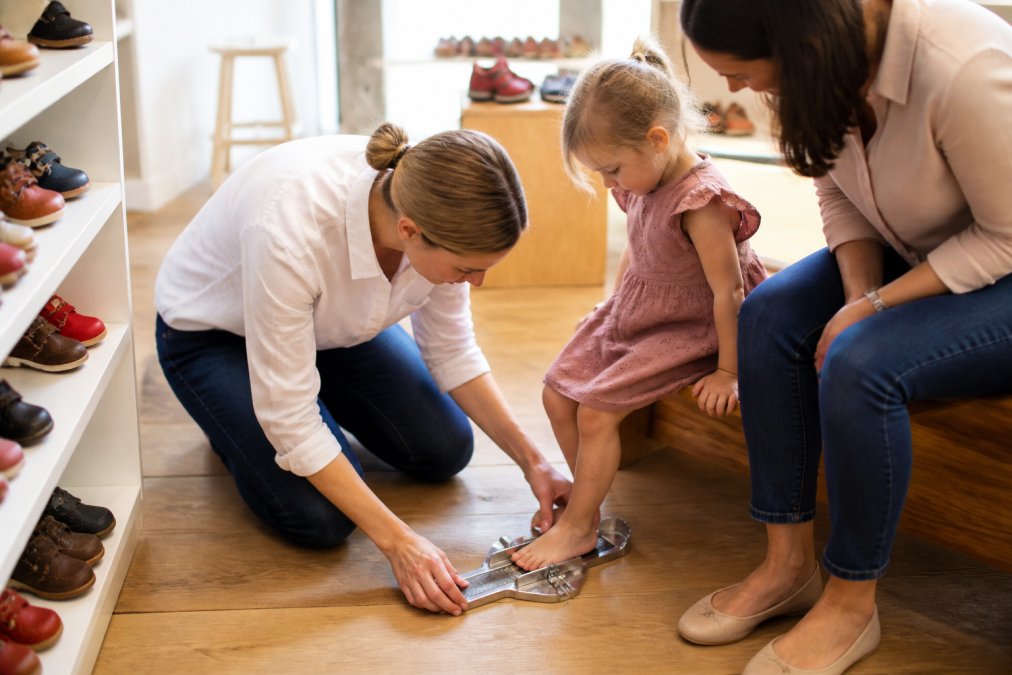
Expect the appointment to move through these stages:
- Standing measurement. Both feet are measured while your child stands, because feet spread and lengthen under body weight. A seated measurement routinely under-reads length by a few millimetres, which is enough to put a child in the wrong size. The fitter notes the longer foot and sizes to it.
- Static fit check. With the shoe on, the fitter presses the upper to locate the longest toe, then checks that the widest part of the foot (the ball) sits at the widest part of the shoe. If those two points are misaligned, the shoe will never fit properly no matter what the size label says.
- Gait observation. Your child walks the length of the shop while the fitter watches foot strike, heel position and toe-off. This is where pronation, supination, and a toe-gripping pattern show up. A child who curls their toes to keep a shoe on is telling the fitter the shoe is too long, not too short.
- Trial fitting in motion. Several pairs are tried in the correct size, and your child walks, runs and climbs in the leading candidate before you commit. Shoes that feel fine standing often reveal heel slip, instep pressure, or a stiff sole the moment a child moves.
- Recommendation and reasoning. The fitter explains what fits and why, and flags anything to watch. A good fitter will also tell you when a shoe does not fit, which is more useful than a sale.
At MintMouse, this is where our fitting service earns its keep. Our size range runs from 18 to 42, and our range includes barefoot models with a wide toe box and zero heel drop, such as the Froddo Barefoot FIRST STEP in dark blue, which suits first shoes where toe splay and ground feel matter most. For children who need extra protection around the toe, the [Emel first shoes with bumper(/products/2810e-emel-first-shoes-with-bumper) | mintmouse.lu] adds a reinforced front without sacrificing flexibility.
Why this is more than a retail transaction
Most shoe shops sell you a size. An expert fitting assesses a foot. The difference matters most for children with a diagnosed condition or a clear gait pattern, because the shoe has to work with the foot rather than against it. A fitter watching a child walk is looking for the same broad signals a podiatrist would note in a referral: how the heel lands, whether the arch collapses under load, whether the toes splay or grip. That is why a fitting appointment is best understood as a health check with a shoe recommendation attached, not a shopping trip with a measurement stop.
If your child has been referred by a podiatrist, bring the paperwork. It changes what the fitter looks for and which shoes they will suggest first, and it may mean a particular last shape or fastening is the right starting point rather than a general-purpose model.
DIY Measurement vs Professional Fitting: What the Tape Measure Misses
Measuring at home gets you a length in centimetres. It does not tell you whether the shoe's internal shape matches your child's foot morphology, and that gap is where most fit problems begin. Two shoes labelled the same size can differ by several millimetres internally depending on the last they are built on.
What a tape measure cannot capture:
- Pronation and supination. How the foot rolls inward or outward through the step.
- Heel-to-toe drop. The height difference between heel and forefoot, which affects how the foot loads.
- Midsole cushioning and stability features. Whether the shoe supports or over-controls a developing foot.
- Orthotic compatibility. Whether a removable insole leaves enough depth for a prescribed orthotic.
- Toe box width in practice. A number on a box does not describe the shape of the space inside.
Home measurement is a useful first step. It is not a substitute for a fit assessment, particularly for a child with wide feet, a high instep, or a diagnosed condition. For those children, a professional fitting is the difference between a shoe that works and one that gets worn twice.
After the Fitting: Caring for Leather Shoes and Planning the Next Visit
A fitting is a snapshot, not a permanent state. Children's feet change between appointments, and shoes change with them. The most useful thing you can do after a fitting is set up a simple maintenance and wear-tracking routine, because that is what catches a fit problem before it becomes a foot problem.
Leather care that actually extends the shoe's life
Leather shoes last longer when they are allowed to dry between wears and cleaned by hand with a soft cloth. Rotate between two pairs if you can, since leather needs a rest day to shed moisture. Keep shoes away from radiators and direct sun, which dry the leather and stiffen it. A stiff upper stops flexing with the foot, which is the point at which a correctly fitted shoe starts to feel wrong.
A simple weekly routine is enough:
- Wipe the upper with a soft, slightly damp cloth and let it air-dry away from heat.
- Check the fastening (laces, Velcro, buckle) for stretch or wear, since a loosened fastening is the most common cause of a shoe that suddenly feels too big.
- Look inside the shoe for a compressed insole or a ridge where the foot has been pressing.
- Check the sole edges for uneven wear, which is the earliest visible sign of a gait pattern worth mentioning at the next fitting.
Reading wear signals between appointments
Most parents only notice a fit problem when the shoe is already too small. Tracking wear signals catches it earlier. Watch for:
- Toe marks or scuffing at the very front of the shoe, which usually means the toes are reaching the end.
- Your child pushing their heel down to get the shoe on, which suggests the shoe has become too short or the fastening has stretched.
- Red marks or rubbing on the skin after a normal day, which points to pressure the fitter should see.
- A shoe that suddenly feels loose, which usually means the fastening has stretched rather than the foot shrinking.
- Uneven sole wear on one side, which is a gait signal rather than a size signal.
If you see two or more of these at once, bring the refit forward rather than waiting for the calendar date.
Planning the next visit
Plan the next visit the day you leave the shop. For a child under three, book the refit for six to eight weeks out. For older children, three to four months. Booking at the fitting removes the scheduling problem entirely, which is the reason most parents skip refits in the first place.
A quick note on hand-me-downs and second-hand shoes
Hand-me-downs are common and can work, but they carry a fit risk. A shoe that has moulded to another child's foot has already taken on that foot's shape, including any pronation or wear pattern. For a first pair, or for a child with a diagnosed condition, a fresh fitting is worth more than a saved pair. For a second pair in a rotation, a hand-me-down in good condition is a reasonable option as long as the sole is not worn unevenly and the upper still flexes.
Frequently Asked Questions
What is a shoe fitting specialist called?
A shoe fitting specialist is often called a fitter, a children's footwear specialist, or a pedorthist depending on their training. In a children's shoe shop, the fitter measures foot length and width, checks heel grip and toe room, and watches how your child walks before recommending a style. At MintMouse, the fitting team also assesses foot volume and arch support needs, then matches the child to shoes such as the Froddo Barefoot FIRST STEP or Emel classic first shoes.
How often should you get a child's feet measured?
Children under three should have their feet measured every two to three months, and children aged three to five every three to four months. Growth spurts can add a full size in weeks, so a shoe that fitted in spring may pinch by midsummer. Book a shoe fitting appointment each season, and sooner if your child starts tripping, refuses to walk, or you notice redness on the toes or heels.
Is it better to have shoes fitted by a professional?
Yes, for children still growing. A professional fitting catches things a home measurement misses, including toe box width, heel slip, foot volume, and how the sole flexes with your child's gait. Online ordering works when you already know the exact size and model, but first shoes and any change in brand or style are worth fitting in person. MintMouse stocks sizes 18 to 42 and can check fit on the spot.
Do I need an appointment for a professional shoe fitting?
Many children's shoe shops take walk-ins, but booking ahead is better during back-to-school season and school holidays. An appointment gives the fitter time to measure both feet, watch your child walk, and try several pairs without rushing. Bring socks, any orthotic insoles your child uses, and the shoes they currently wear so the fitter can compare wear patterns.