


Table of Contents
- 7 Signs Toddler Shoes Are Too Small
- Physical Signs You Can See
- Behavioral Signs You Can Spot
- How to Measure Toddler Feet at Home
- How Often to Refit Children Shoes
- Signs of Foot Pain in Toddlers You Should Not Ignore
- Why Shoes That Are Too Small Harm Foot Development
- How to Choose Shoes That Fit Right the First Time
- Frequently Asked Questions
Last Updated: September 28, 2026
7 Signs Toddler Shoes Are Too Small
Learning to spot the signs toddler shoes are too small early protects your child from pain, falls, and long-term foot problems. Children's feet are soft and flexible, so damage from cramped footwear often happens quietly. This guide covers the physical and behavioural clues to watch for, how to measure feet at home, and when to refit.
Physical Signs You Can See
The most reliable evidence sits inside the shoe, not on the size label. Press your thumb across the front: you should feel 10-12 mm of space between the longest toe and the shoe's end, roughly a thumb's width. This is the thumb test, and it is the single fastest at-home check you can run.
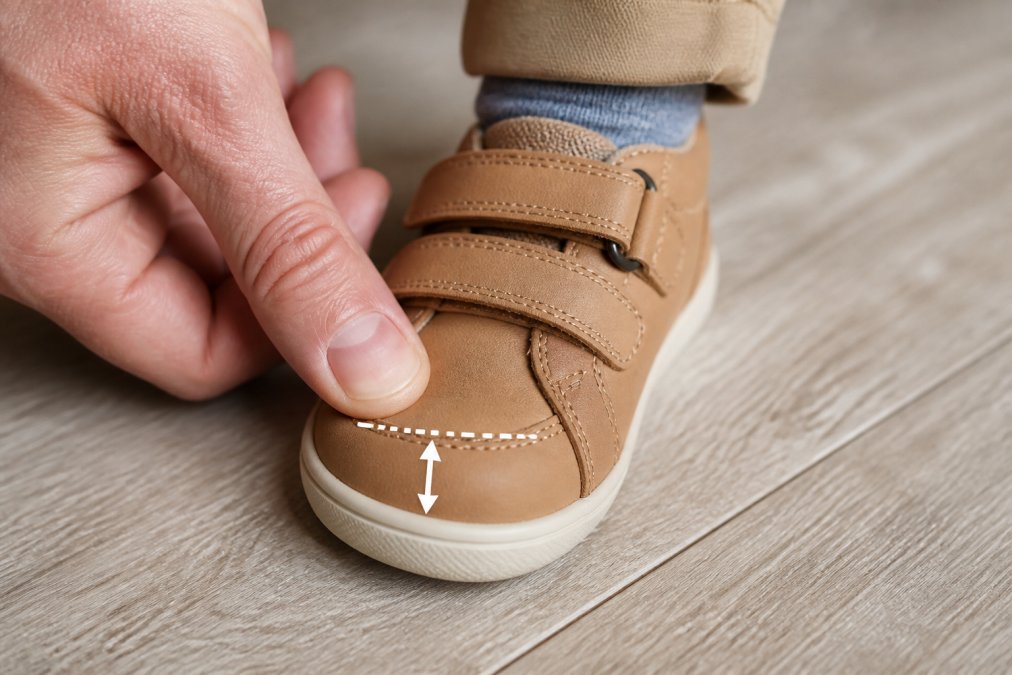
Here is how to run it properly:
- Have your child stand (not sit) with weight on both feet.
- Press your thumb firmly on the front of the shoe, just past the longest toe.
- You should feel a clear gap before your thumb meets resistance from the toe.
- If your thumb cannot press down at all, the shoe is too small.
- If you can press more than a thumb's width, the shoe is too big and will cause tripping.
Beyond the thumb test, look for these physical markers:
- Red marks, pressure points, or blisters on toes and heels
- Toes curled or bunched against the front
- Ingrown toenails or persistent rubbing on the little toe
- Heel slippage, or the opposite: a heel that will not sit back into the heel counter
- Uneven shoe wear patterns, especially at the toe or outer edge
- A shoe that leaves deep sock indentations after a short walk
Why width and foot shape matter as much as length
A shoe can pass the thumb test and still be too small if your toddler has wide or high-volume feet. Length and width are separate measurements, and most brands only publish length. If your child has a wide forefoot, a high instep, or a narrow heel, a shoe that is correct in length can still compress the toes or rub the sides.
Signs that width, not length, is the problem:
- Red marks along the outer edge of the big toe or the little toe
- The upper looks stretched or bulging over the foot
- Your child's toes overlap or cross when the shoe is on
- The shoe is hard to put on even though the length seems right
Brand sizing is not standardized
Two pairs marked the same size can differ by a full centimetre in the toe box. European sizes (EU), UK sizes, and US sizes do not convert cleanly, and even within one system, brands use different lasts. Always measure your child's foot in centimetres, add 10-12 mm, and match that number to the specific brand's own size chart, never a generic conversion.
Behavioral Signs You Can Spot
Other behavioural flags:
- Tripping more often, or a stiff, flat-footed gait
- Toe-walking or an odd rolling motion through each step
- Reluctance to run and play at the pace of siblings
- Fussing during shoe changes, or resisting putting them on at all
If your child has sensory processing differences, they may react strongly to seams, tags, or tight fastenings even when the size is correct. In that case, prioritise soft, breathable materials and adjustable fastening mechanisms over firm structure.
How to Measure Toddler Feet at Home
Measuring toddler feet at home takes about five minutes and needs only paper, a pencil, and a ruler. Do it in the evening, when feet are at their largest, and always measure both feet, most children have one foot slightly longer than the other, and you should fit to the longer one.
- Stand your child on a sheet of paper against a wall, heel touching the skirting.
- Mark the tip of the longest toe with a pencil held vertically.
- Repeat for the other foot.
- Measure heel-to-toe in centimetres with a ruler.
- Add 10-12 mm for growth allowance.
- Match the total to the brand's own size chart, never a generic conversion.
Measuring width, not just length
Length alone is not enough. Use a soft tape measure or a piece of string to measure the widest part of the foot, usually across the ball just behind the toes. Write both numbers down. When you shop, look for brands that publish width or that are known for a wide toe box. If your child's width measurement is at the top of a brand's range, size up in width or choose a different brand rather than sizing up in length.
Converting centimetres to EU, UK, and US sizes
Sizing systems do not line up. As a rough guide, a foot measuring 14.2 cm needs a shoe with an internal length of roughly 15.2-15.4 cm, which typically lands between EU 23 and 24 depending on the maker. The same foot is roughly UK 6-6.5 and US 7-7.5 in toddler sizing, but these conversions vary by brand and by whether the shoe is a pre-walker or a first-walker.
A practical approach:
(44112.125.1691) Bisgaard Barefoot Baloo →
- Measure in centimetres first. This is the only number that is consistent.
- Add 10-12 mm for growth.
- Find the brand's own size chart and match your total internal length to it.
- Ignore the size on the old shoe. It tells you nothing about the new brand.
- If you are between sizes, go with the larger size only if the shoe has adjustable fastening; otherwise choose the brand that fits your child's width.
When to remeasure
Remeasure every 8-12 weeks for toddlers, and every 4-6 weeks during a growth spurt. If you are buying online and cannot try the shoe on, order two sizes when the return policy allows it, keep the one that passes the thumb test and the width check, and send the other back. Consistent monitoring of these measurements ensures a proper fit across all footwear, much like the systematic approach used to verify baby gear sizes.
How Often to Refit Children Shoes
How often to refit children shoes depends on age and growth stage, but most toddlers need a new size every two to three months. Growth spurts can compress that to six weeks.
| Age / Stage | Typical Refit Interval | What to Check |
|---|---|---|
| 0-12 months (pre-walkers) | Every 6-8 weeks | Soft sole, no restriction |
| 1-3 years (toddlers) | Every 8-12 weeks | 10-12 mm toe room |
| 3-5 years | Every 3-4 months | Arch support, wear patterns |
| During a growth spurt | Every 4-6 weeks | Sudden tightness |
Signs of Foot Pain in Toddlers You Should Not Ignore
Watch specifically for:
- A limp that appears without injury
- Toes that overlap, curl, or point inward when relaxed
- Persistent rubbing that breaks the skin
- A child who walks on tiptoe long after learning to walk flat
Persistent pressure from undersized footwear is one factor clinicians associate with later toe deformities and nail problems.
Why Shoes That Are Too Small Harm Foot Development
Toddler feet are largely cartilage, and the bones do not fully harden until the teenage years. Cramped shoes interfere with that process at the exact stage when the arch and natural gait are forming.
The consequences compound:
- Restricted toe movement weakens the muscles that build the arch
- Constant friction causes blisters that scar and thicken skin
- An ill-fitting sole alters gait, which can affect knee and hip alignment
- A rigid or undersized shoe limits sensory feedback from the ground
How to Choose Shoes That Fit Right the First Time
Buying by brand chart plus a home measurement catches most problems before they start. The remaining variables are width fitting, foot shape, and how the shoe fastens.
Check these before you commit:
- Wide toe box that lets toes splay flat
- Flexible sole that bends where the foot bends
- Firm heel counter for stability
- Breathable materials such as natural leather
- Adjustable fastening to accommodate instep height
Frequently Asked Questions
How often do toddlers need bigger shoes?
Toddler feet can grow half a size every two to three months, and faster during growth spurts. Check the fit every four to six weeks by pressing the toe box to feel for about 10 to 12 mm of space in front of the longest toe. If that gap has closed, it is time for new shoes. Regular checks matter more than a fixed calendar because growth is not steady.
Is it okay to buy toddler shoes one size up?
No. Shoes that are too big cause heel slippage, tripping, and blisters from friction, and they force the toes to grip to keep the shoe on. That gripping pattern can affect gait over time. Aim for 10 to 12 mm of growth room in front of the toe, which is roughly one thumb width, and nothing more. A proper fit supports the foot without letting it slide.
How much extra space should toddler shoes have?
Leave 10 to 12 mm between the longest toe and the front of the shoe. Test this with the thumb test: press down on the toe box while your child stands. You should feel a small gap, not the toe pressing back. Also check the width, because a shoe can be long enough but pinch across the instep or toe box, leaving red marks after a short walk.
Can ill-fitting shoes cause long-term foot problems in toddlers?
Shoes that are too small restrict natural toe movement, press on the toes, and increase the risk of ingrown toenails, blisters, and pressure points. Over time, repeated pressure during growth can contribute to toe deformities and affect gait. Toddler feet are still forming, so a shoe that allows a wide toe box, a flexible sole, and proper alignment supports healthy development rather than working against it.
Finding shoes that fit properly is harder than it should be, because sizing varies between makers and toddler feet change faster than most parents expect. MintMouse takes the guesswork out of it with an expert fitting service, handmade leather shoes chosen for healthy foot development, and a size range from 18 to 42 that covers children with wide, narrow, and standard feet. Get started with MintMouse and give your child footwear that supports every step from the first one.