


Table of Contents
- What Are Bunions in Toddlers and Why Early Action Matters
- What to Look for in Barefoot Baby Shoes for Bunions
- Signs of Foot Pain in Toddlers: When to Seek Help
- How to Measure Toddler Feet for Shoes at Home
- Top Barefoot Shoes for Toddlers with Bunions
- Transitioning from Barefoot to Shoes and Shoe Modification Tips
- Long-Term Impact of Early Intervention
- Frequently Asked Questions
Last Updated: September 30, 2026
What Are Bunions in Toddlers and Why Early Action Matters
Finding the best shoes for toddlers with bunions starts with understanding what you are actually looking at. A bunion in a toddler is not the same problem as an adult bunion, and treating it like one leads parents down the wrong path. At MintMouse, we fit children's feet, and we often see parents buying stiff, structured shoes to "correct" a bump that flexible footwear would handle better.
Juvenile hallux valgus is the medical term for a bunion that develops in childhood, where the big toe drifts toward the other toes and the joint at its base pushes outward. In toddlers, this is usually a positioning issue rather than a fixed deformity. The bones are still soft, and the joint alignment can change significantly depending on what the foot is doing all day.
Why does early action matter so much? Because toddler feet are still forming.
What to Look for in Barefoot Baby Shoes for Bunions
When parents ask what to look for in barefoot baby shoes, the answer comes down to three things: space, flexibility, and feedback. A shoe that restricts any of these works against a developing foot.
The Role of a Wide Toe Box and Flexible Soles
A wide toe box lets the toes splay naturally when your child stands and pushes off. This matters enormously for a toddler with a bunion, because toe splay distributes pressure evenly across the front of the foot instead of concentrating it at the big toe joint. Look for a straight last, meaning the shoe's inner edge runs roughly straight from heel to toe rather than curving inward.
Other features worth checking:
- Heel counter: should be soft and low, not rigid. A firm heel counter locks the foot in place and limits natural motion.
- Zero heel drop: the heel and toe should sit at the same height. A raised heel shifts weight forward onto the toes.
- Adjustable closures: straps or laces let you fine-tune fit as the foot changes shape through the day.
- Breathable materials: leather and textile uppers keep the foot from overheating and slipping.
Signs of Foot Pain in Toddlers: When to Seek Help
Toddlers cannot always tell you their feet hurt, so you have to read the signals. The signs of foot pain in toddlers usually show up as changes in how they move, not as complaints.
Watch for these behaviours:
- Refusing to walk when they normally run everywhere
- Pulling at or rubbing one foot repeatedly
- Tripping more often than usual, or a sudden change in toddler gait
- Walking on tiptoes or on the outer edge of the foot
- Redness, rubbing marks, or blisters along the big toe joint
- Out-toeing or in-toeing that appears or worsens
- Crying during or after shoe removal
How to Measure Toddler Feet for Shoes at Home
Measuring at home takes about five minutes and gives you a reliable starting point for footwear fit. Do it at the end of the day, when feet are at their largest.
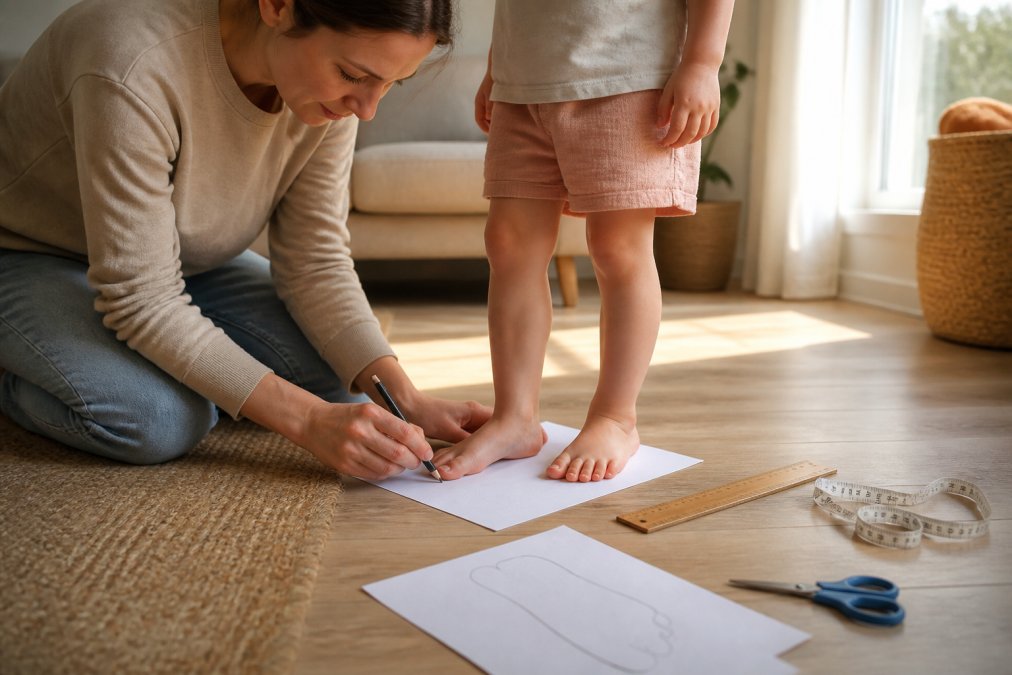
- Stand your child on a sheet of paper, heel against a wall.
- Mark the tip of the longest toe and the back of the heel.
- Measure the distance in centimetres with a ruler.
- Repeat for both feet, and use the longer measurement.
- Add 0.5 to 1 cm of growing room, no more.
- Compare against the insole measurements listed for the shoe you are considering.
| Insole Length | Typical EU Size | Growing Room to Add | Check Frequency |
|---|---|---|---|
| 11.9 cm | 20 | 0.5-1 cm | Every 6-8 weeks |
| 12.5 cm | 21 | 0.5-1 cm | Every 6-8 weeks |
| 13.2 cm | 22 | 0.5-1 cm | Every 6-8 weeks |
| 14.0 cm | 23 | 0.5-1 cm | Every 6-8 weeks |
| 14.7 cm | 24 | 0.5-1 cm | Every 6-8 weeks |
Top Barefoot Shoes for Toddlers with Bunions
These are the models we fit most often for toddlers showing early bunion signs. Each one shares the essentials: a wide toe box, a flexible sole, and a soft upper that does not press on the joint.
Froddo Barefoot FIRST STEP: Best for First Walkers
The Froddo Barefoot FIRST STEP is a great option for a child just starting to walk. The upper is natural leather with a chrome-free leather lining, and the double fastener closure makes it easy to adjust around a wider forefoot.
Froddo Barefoot FIRST STEP - Dark BLUE →
Naturino Barefoot Amur and Sabby: Best for Soft Leather Comfort
The Naturino Barefoot Amur VL is a very soft shoe. The leather upper wraps the foot without pressure points, and the rubber sole has a reinforced toe cap that protects little toes during floor play. The strap closure adjusts quickly, and the leather lining keeps the foot from sliding.

Froddo Barefoot Base and Zeru: Best for Active Toddlers
Once your child is running, the Froddo Barefoot Base Low trainers are a suitable next step. The upper combines water-repellent natural leather with textile, and the double fastener closure keeps everything in place during play. The wider toe box and zero heel drop carry over from the FIRST STEP, so the transition is seamless.
| Model | Price | Best For | Standout Feature |
|---|---|---|---|
| Froddo FIRST STEP | €75.95 | First walkers | Lifolit outsole, zero heel drop |
| Naturino Amur VL | €89.00 | Soft leather comfort | Enveloping leather upper |
| Naturino Sabby VL | €86.90 | Floor play | Reinforced toe, structured heel |
| Froddo Base Low | €74.50-€79.95 | Active toddlers | Water-repellent leather, wide size range |
| Froddo Zeru Loop | €84.95 | Warm feet | Quick-drying microfibre insole |
Transitioning from Barefoot to Shoes and Shoe Modification Tips
Moving from barefoot time to shoes takes a little planning, especially for a child with a bunion. The goal is to keep the foot doing as much work as possible while still protecting it outdoors.
A few modification tricks that work well:
- Loosen the lower strap on double-fastener shoes. The upper strap holds the heel; the lower one controls width. Backing it off one notch often solves pressure at the toe joint.
- Remove the insole if the shoe feels tight across the top. Most barefoot models have a removable insole, and taking it out adds a few millimetres of depth.
- Check the toe box daily by pressing your thumb across the front. If you cannot feel the toes move freely, the shoe is too tight.
- Rotate two pairs so each has time to dry and the materials stay soft.
Long-Term Impact of Early Intervention
What happens in the toddler years shapes the foot for life. Pediatric podiatry guidance consistently points to the same conclusion: catching alignment issues early, while the foot is still forming, gives the best chance of a good outcome.
Frequently Asked Questions
What shoes do podiatrists recommend for toddlers with bunions?
Podiatrists generally recommend shoes with a wide toe box, flexible soles, and adjustable closures. Barefoot-style shoes that allow natural toe splay and don't compress the big toe joint are often suggested. Look for soft leather uppers, zero heel drop, and enough room for the foot to move freely. MintMouse's fitting service can help you find the right size and shape for your toddler's specific foot needs. Always consult a pediatric podiatrist for a proper diagnosis and personalized advice.
Is it normal for toddlers to develop bunions?
Bunions in toddlers are not common but they do occur. Juvenile hallux valgus can develop from genetic factors, flat feet, or ill-fitting shoes that compress the toes. While some children are born with a tendency toward bunions, tight or narrow footwear can make the problem worse. If you notice a bump at the base of your toddler's big toe, it's worth having a pediatric podiatrist evaluate it. Early intervention with proper footwear can prevent progression.
Are barefoot-style shoes good for toddlers with bunions?
Barefoot shoes can be a good choice for toddlers with bunions because they allow the toes to spread naturally and don't put pressure on the bunion joint. Look for shoes with a wide toe box, flexible sole, and no heel rise. MintMouse's barefoot options, like the Froddo FIRST STEP or Naturino Amur, are designed with these features. However, every child's foot is different, so a professional fitting is recommended to ensure the shoe supports your toddler's specific needs.
How can I tell if my toddler is experiencing foot pain from bunions?
Signs of foot pain in toddlers include limping, refusing to walk, pulling at their shoes, or crying when you touch their feet. You might also notice redness, swelling, or a visible bump at the base of the big toe. Some children become less active or want to be carried more often. If your toddler shows any of these signs, remove their shoes and check their feet. Persistent pain or discomfort warrants a visit to a pediatric podiatrist for proper assessment.
Do bunions in toddlers require medical intervention?
Not always. Mild bunions in toddlers can often be managed with proper footwear that accommodates the foot shape and reduces pressure on the joint. A pediatric podiatrist may recommend wide, flexible shoes, orthotics, or stretching exercises. In more severe cases, where pain affects walking or the bunion progresses quickly, medical intervention may be needed. Early action with correctly fitted shoes from a specialist fitter can make a significant difference in preventing long-term issues.